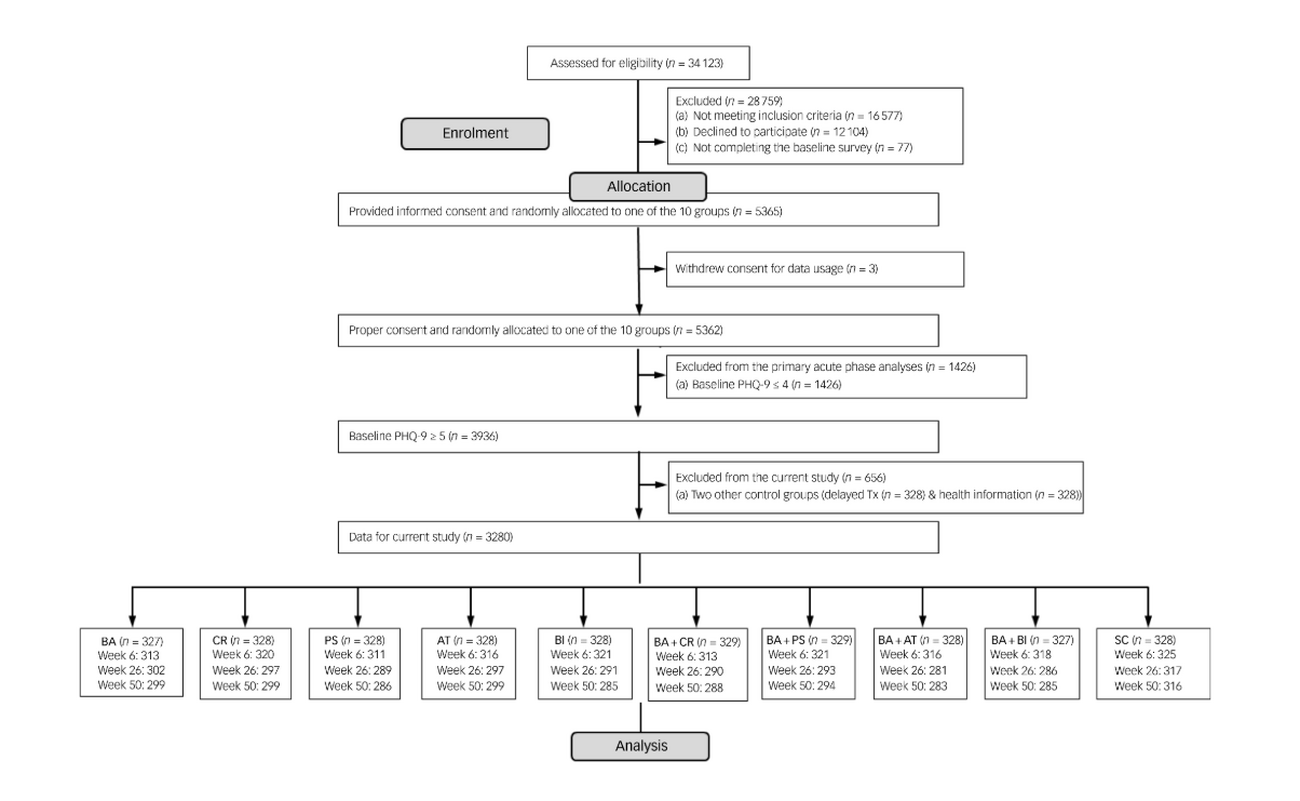
A new 50-week analysis in The British Journal of Psychiatry by Akechi and colleagues examined smartphone-delivered CBT skills among 3,280 Japanese adults with subthreshold depression. Participants were assigned to one of nine intervention conditions or a self-monitoring control. The brief modules taught behavioural activation, cognitive restructuring, problem-solving, assertion training, behavioural treatment for insomnia, or selected combinations of these skills.
When all active conditions were pooled, they were associated with a lower risk of developing major depression than self-monitoring alone, with a hazard ratio of 0.66 and an estimated number needed to treat approximately 26—although the confidence interval around that estimate was wide. Behavioural activation plus assertion training had the strongest preventive point estimate, while behavioural activation plus cognitive restructuring produced the largest reduction in overall depressive-symptom burden. Symptom effects were nevertheless small, and problem-solving alone was among the less effective and less well-adhered-to options.
The study also generated suicidality alerts for 141 participants, or 4.3% of the sample, despite recruiting people with subthreshold rather than established major depression. No serious adverse events were reported. Interpretation should remain cautious because relatively few participants developed major depression, several estimates were imprecise, and the investigators modified which control condition was used for the principal comparison after observing that another information-based condition appeared to behave like an active intervention.
Clinical Takeaway: For people with emerging or subthreshold depression, focused CBT skills may be useful before a full major depressive episode develops. Match the intervention to the formulation: activation for withdrawal and reduced reinforcement, cognitive restructuring for persistent negative interpretations, assertion training when interpersonal avoidance or difficulty communicating needs is prominent, and behavioural sleep treatment when insomnia is maintaining vulnerability. Digital prevention should still include symptom measurement and an explicit human response pathway for worsening depression or suicidal thinking.